Patterns Exist Everywhere. We Just Choose to Ignore Them.
Here's something most traders know but don't like saying out loud.
The patterns aren't hidden.
Fibonacci levels, support and resistance, moving averages. It's all in every book, every video, every forum thread. If you've been at this longer than six months you've seen all of it.
So why do most of us still lose money?
That question is what actually changed my trading. Not a new indicator.
The part I find genuinely fascinating
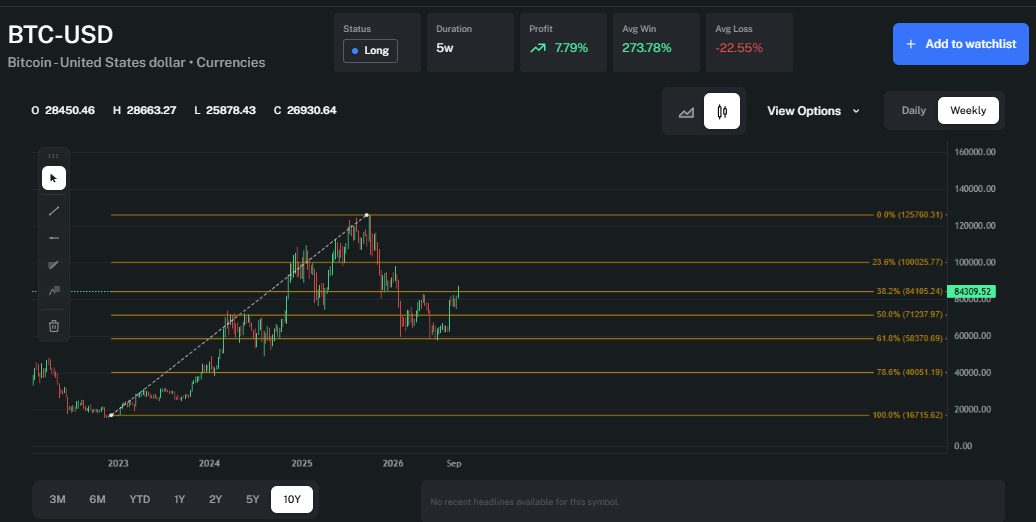
Markets don't move in straight lines. They push, they pull back, they push again. That's the basic idea behind Elliott Wave, and once you see it you can't unsee it.
And here's the thing that opened my eyes when I first got into this: Fibonacci numbers turn up everywhere in nature. The spiral of a shell. The way a tree branches. The seeds in a sunflower. The same ratios, in systems that have nothing to do with each other. I'm such a geek that I checked it on a spreadsheet myself.
Markets are no different. At the end of the day it's just a game of supply and demand, and the same shapes keep showing up in the price structure.
Now I want to be careful here, because this is where a lot of trading content oversells.
I'm not going to tell you Fibonacci levels are some hidden law of the universe that guarantees a bounce. They're not. Plenty of pullbacks blow straight through every level on the chart.
What I'd say is simpler: A lot of people are watching the same levels. Enough of them that those zones end up mattering more than they probably should. That's not magic, it's just crowd behaviour, and crowd behaviour is worth paying attention to.
So the levels don't tell you what will happen. They tell you where to look.
Why knowing this isn't enough
The European Securities and Markets Authority looked at retail trading data across Europe and found between 74% and 89% of retail traders lose money. That's not a small unlucky group. That's almost everyone.
And I don't think it's because people can't read a chart.
We live in constant information overload. Headlines, threads, alerts firing at all hours. There's always something shouting for your attention, and all of it is built to make you feel something. Fear, then greed, then fear again.
And honestly? Part of us likes it. The urgency, the sense that something big is about to happen. It's exciting. It's also the exact thing that gets in the way.
So you spot your level. You've done the work. You know the zone. Then a headline lands, or price dips one more percent, and you're out. Or you jump in three days early because you can't stand the thought of missing it.
The read was right. You just got in your own way.
I did that for years.
What actually changed
Day trading meant making decisions while the money was moving. Adrenaline, noise, a live position sitting in front of me. Nobody thinks clearly in that state, and I was no exception.
Now I do my reading after the close. The market's shut. Nothing's moving. Nothing can be done until tomorrow anyway.
That's not me being more disciplined. It's me not needing to be.
The decision gets made by someone calm, with time, looking at a chart that isn't going anywhere. The next morning I just follow what that person decided.
I'm not fighting myself less often. I took the fight out of the process.
Something you can use today, whether or not you ever hear from me again
If you take one thing from this, take this.
Decide before, not during.
Before the market opens, write down the level you're watching, what would make you act, and what would make you walk away. On paper, or in a note, somewhere you can't quietly rewrite it later.
Then close the chart.
The point isn't the writing. It's that the decision gets made by the version of you that isn't currently watching money move. Those two people are not the same, and the calm one is better at this.
You don't need any tool to do that. Ten minutes and a bit of honesty.
What I do now
Every evening after the close I go through my watchlist. Not to react to anything, just to see where things sit. When something lines up, Finactiq flags it, and the next morning I decide whether it fits the plan I already wrote down.
No intraday watching. No 3am alarms. Just a read, once a day, when the market's already shut.
And on Sunday I spend about ten minutes on SPY and QQQ. Where are we in the move, are we near a level that matters, is the trend still holding. That's my whole week planned.
That Sunday read is what goes into the free Week Ahead Briefing. If it's useful to you, it's below. Want signals on your own watchlist every day before the open? Start a 14-day free trial, no card required.