Keep the Index Fund. Use a System for Everything Beyond It.
The short answer
Passive investing is still the best default for many investors. Low-cost index funds provide broad exposure to a market index without requiring constant buying and selling. The U.S. Securities and Exchange Commission describes index funds as funds designed to track a market index, generally through a passive strategy that trades less frequently than an actively managed fund. 1
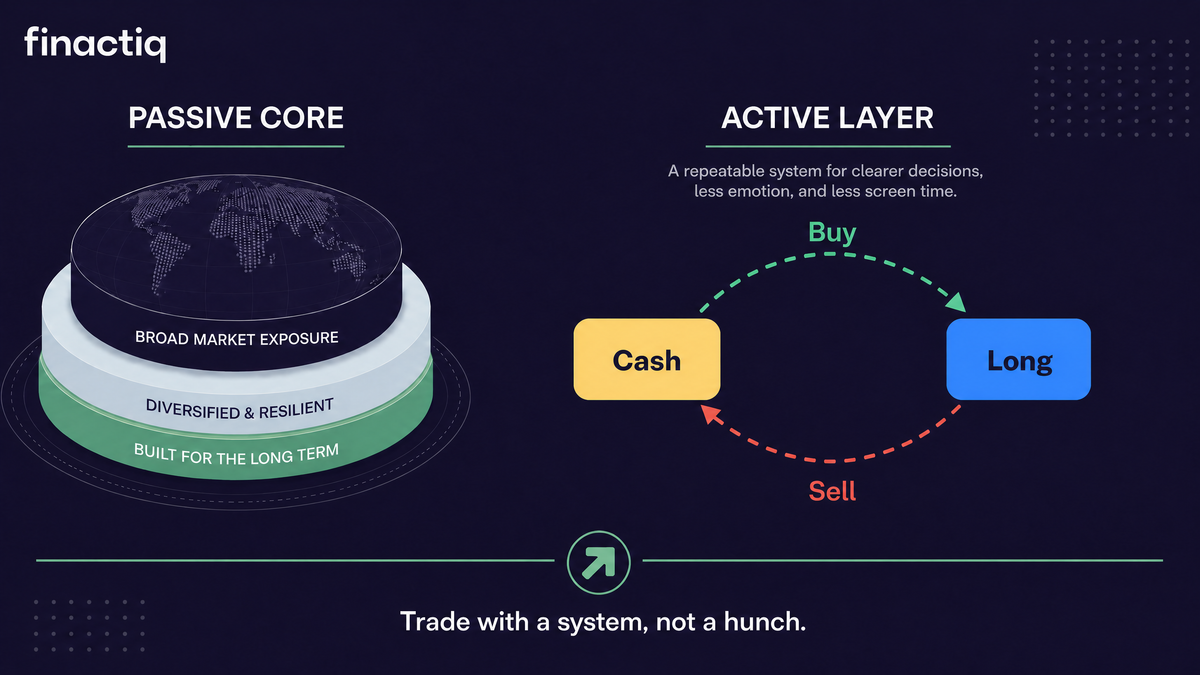
But passive versus active is the wrong choice for most people. You do not have to choose between owning the market and making selective decisions. A more practical approach is to use a passive core for broad, low-cost exposure and a smaller active satellite for the positions or market conditions you want to follow more deliberately.
The difficult part is not finding more opinions. It is deciding what deserves attention, recognising when conditions are changing, and acting without spending every evening reading headlines or staring at charts.
That is where a market-intelligence engine such as Finactiq fits. Finactiq is not a fund, broker, or financial adviser. It is software designed to bring market analysis and signals into one workflow, helping busy investors make active decisions with a repeatable process rather than a hunch. 2
Keep the index fund. Use a system for everything you want to do beyond it.
Three ideas to remember
First, use passive investing for the foundation. In large, liquid markets, low-cost index exposure is difficult for active funds to beat consistently after fees. SPIVA, the long-running S&P Dow Jones Indices research program, measures actively managed funds against comparable benchmarks across regions and asset classes. 3
Second, treat active investing as a decision layer, not an identity. An investor can retain a diversified passive core while making selective decisions about a smaller allocation to individual stocks, sectors, or market conditions.
Third, use a system for the active part. The goal is not more screen time or more predictions. It is a repeatable way to decide what to watch, what has changed, and whether the right action is to buy, hold, sell, or stay in cash.
What passive investing does well
An index fund seeks to track the returns of a market index such as the S&P 500, the Russell 2000, or a total-market index. An index itself is a basket of securities designed to represent a market, sector, or part of an economy. Investors cannot buy an index directly, but an index fund provides an indirect way to gain that exposure. 1
The attraction is straightforward. Passive funds can offer diversification, a transparent mandate, relatively little portfolio turnover, and a process that does not depend on correctly identifying the next winning stock. Because passive funds generally do not require a large team of analysts to select securities, their operating costs may be lower than those of actively managed funds. 1
Fees matter because they reduce the return an investor keeps. The SEC notes that when two funds have identical performance, the lower-cost fund will generally produce the higher return for the investor. It also cautions that not every index fund is automatically cheaper, so investors should check the actual expense ratio and other costs before investing. 1
Passive investing is therefore compelling for a simple reason: it gives investors a disciplined way to participate in market growth without requiring them to make a continuous series of predictions.
That does not mean passive investing eliminates risk. An index fund remains exposed to the securities and risks represented by its index. A fund can also underperform its index because of fees, trading costs, or tracking error. Market-cap-weighted indexes may place larger weights on companies with higher market values, regardless of whether those valuations later prove reasonable. 1
Passive investing is a strong foundation. It is not a guarantee, and it is not a complete answer to every investor's objective.
What the evidence says about active funds
Active investing means deliberately choosing what to own, when to buy or sell, and how much to allocate, usually with the goal of outperforming a relevant benchmark. An active mutual fund delegates those decisions to a manager. An individual investor makes them directly.
Those two forms of active investing are often treated as the same thing, but they are not. The evidence most often cited in the passive-versus-active debate concerns professionally managed funds and their performance after fees. It should not automatically be interpreted as proof that every form of individual decision-making is futile.
The evidence is still important. SPIVA has measured active funds against index benchmarks for more than two decades, and its scorecards consistently show how difficult it is for many active funds to outperform their benchmarks over long periods after costs. 3 The exact result depends on the market, category, time period, benchmark, and whether survivorship is included, so the relevant comparison should always be checked rather than reduced to a single universal percentage.
The practical lesson is not that active management is impossible. It is that the hurdle is high, especially when a product charges significant fees for a result that may not exceed a low-cost benchmark. A manager must first overcome expenses, trading costs, taxes where applicable, and the difficulty of consistently finding opportunities in a market watched by many professional participants.
For many investors, this makes a low-cost passive fund a rational default. But it leaves a separate question unanswered: what should an investor do with the part of a portfolio they want to manage more deliberately?
The false binary: core and satellite
The choice does not have to be "all passive" or "all active." A core-satellite approach separates two jobs.
The core is designed to provide broad market exposure, diversification, and a relatively simple long-term allocation. For many investors, that core may consist largely of low-cost index funds or ETFs.
The satellite is the smaller, more selective part. It may include individual stocks, sectors, or other positions that an investor wants to follow because of a specific thesis, market condition, or risk-management rule.
The purpose of the satellite is not to turn an investor into a day trader. It is to create room for deliberate decisions without requiring the whole portfolio to depend on them.
| Layer | Primary job | Typical question |
|---|---|---|
| Passive core | Broad, low-cost market exposure | "How do I participate consistently?" |
| Active satellite | Selective exposure and deliberate decisions | "What deserves attention now?" |
| Decision process | Consistency and risk control | "What changed, and what should I do?" |
This structure also clarifies what a tool like Finactiq should and should not do. It should not be presented as a replacement for a diversified core or as a promise of superior returns. Its role is to help make the active layer more systematic.
The active layer needs a system
Active decisions are often made with too much information and too little time. An investor may move between price charts, financial news, newsletters, social media, analyst opinions, and conflicting signals. The result is familiar: buying after a move has already attracted attention, selling in the middle of a decline, or holding on simply because there is no clear rule for changing course.
A system does not remove uncertainty. It gives the investor a consistent way to process it.
That system might include a defined watchlist, screening criteria, a review schedule, rules for entries and exits, and a record of what happened after each decision. It may use multiple types of information rather than relying on a single headline or indicator. Most importantly, it should reduce the distance between analysis and action without encouraging impulsive trading.
For a busy professional, time is part of the problem. The goal is not to consume more market content. The goal is to compress a large amount of information into a smaller number of decisions worth considering.
Where Finactiq fits
Finactiq is a market-intelligence engine for traders and busy professionals. Its public platform brings together screeners, fundamental research, stock news, market sentiment, interactive charts, and daily or weekly signals. Users can build a watchlist or screen more than 3,000 U.S. stocks and ETFs, then review market conditions through the dashboard or an after-close email. 2
The platform's signals are expressed as practical decisions: buy, long, sell, or cash. The underlying analysis combines factors such as momentum, sentiment, volume, support and resistance, and reversal signals. 2
That gives Finactiq a distinct role in the passive-versus-active conversation. It is not asking an investor to abandon index funds. It is not asking them to monitor the market all day. It is designed for the gap between the passive foundation and the active decisions an investor may want to make around it.
Finactiq helps turn market information into a repeatable decision process, so you can trade with a system rather than a hunch.
The benefit is not certainty. No signal eliminates market risk, and no software can guarantee a profit. The benefit is structure: one place to screen for ideas, review relevant market information, monitor a watchlist, and receive a clear signal when conditions change.
That matters because active investing often fails at the process level before it fails at the analytical level. Investors may have a reasonable idea but enter too late, hold too long, react emotionally, or fail to define what would change their view. A repeatable workflow cannot make every decision right. It can make decisions more deliberate and less dependent on mood, noise, and constant monitoring.
What this approach is—and is not
This approach is not a recommendation to replace diversified investing with individual stocks. It is not a claim that every investor should pursue active strategies. It is not a promise that Finactiq will outperform an index, and it is not personalised financial advice.
It is a way to think about roles:
- A passive core can provide broad exposure and a disciplined long-term foundation.
- An active satellite can give an investor room to make selective decisions.
- A market-intelligence system can help organise those decisions around defined signals and a manageable routine.
The right allocation depends on an investor's objectives, time horizon, risk tolerance, financial circumstances, and willingness to accept losses. Investors should consider those factors and, where appropriate, seek advice from a qualified financial professional.
Frequently asked questions
Is passive investing better than active investing?
There is no universal answer, but passive investing is a strong default for many investors because it can provide diversified market exposure at relatively low cost. The evidence from SPIVA shows that many actively managed funds struggle to outperform their benchmarks after fees over long periods. 3 That does not mean every active decision is futile; it means active strategies face a demanding hurdle.
Is Finactiq a replacement for index funds?
No. Finactiq is software for market analysis and algorithmically generated signals. It can support the active portion of an investor's process, while a passive index fund may serve a different role as part of a broader strategy. Finactiq is not a fund, broker, or registered investment adviser. 2
What does Finactiq analyse?
Finactiq's platform describes tools covering stock and ETF screening, fundamental research, news, market sentiment, momentum, volume, support and resistance, interactive charts, and daily or weekly signals. 2 The specific information an investor uses should depend on their own process and objectives.
How much time does Finactiq require?
The platform is designed to reduce the need for constant monitoring by consolidating analysis and delivering signals through the dashboard and email. The intended workflow is to review the information, apply personal judgment, and execute through a preferred trading platform if the investor chooses to act. 2
What can I realistically expect from Finactiq?
Finactiq is designed to help investors trade with a system rather than a hunch. By bringing momentum, sentiment, volume, support and resistance, research, news, and signals into one workflow, it helps users find opportunities faster, manage entries and exits more deliberately, and spend less time watching the market.
Finactiq's historical signal results provide a transparent view of how the system has behaved across past market conditions. They are not a promise of future performance—no market system can make that promise—but they show the process in action and give investors a basis for deciding whether it fits the way they want to invest.
The bottom line
Passive investing is not obsolete. For many people, it remains the most sensible foundation for long-term market participation.
But a foundation is not the whole building. Some investors want to make selective decisions about the stocks, sectors, or market conditions they follow. For them, the real alternative to an expensive active fund is not necessarily a choice between doing nothing and trading all day.
It may be a passive core, a deliberately sized active satellite, and a system that makes the active part easier to manage.
Keep the index fund. Use a system for everything you want to do beyond it.
Disclaimer: Finactiq Limited (NZBN: 9429052500688) is a technology company, not a registered investment advisor, broker-dealer, or licensed financial advisor. Finactiq provides software, data, and algorithmically generated signals for informational and educational purposes only. Nothing on this platform or in this article constitutes personalised investment, financial, legal, or tax advice. Past performance and backtested results are not indicative of future results. Investing involves risk, including the possible loss of principal. Consider your circumstances and consult a qualified financial professional where appropriate.
© 2026 Finactiq