
The Institutionalization of Bitcoin: Halving Cycles in the Era of the GENIUS Act and the Pending CLARITY Act
Bitcoin is down ~48% from its 2025 high. Past crashes hit 77-86%. Here's the regulatory story behind the gap, and the spark that could set off the next big run.
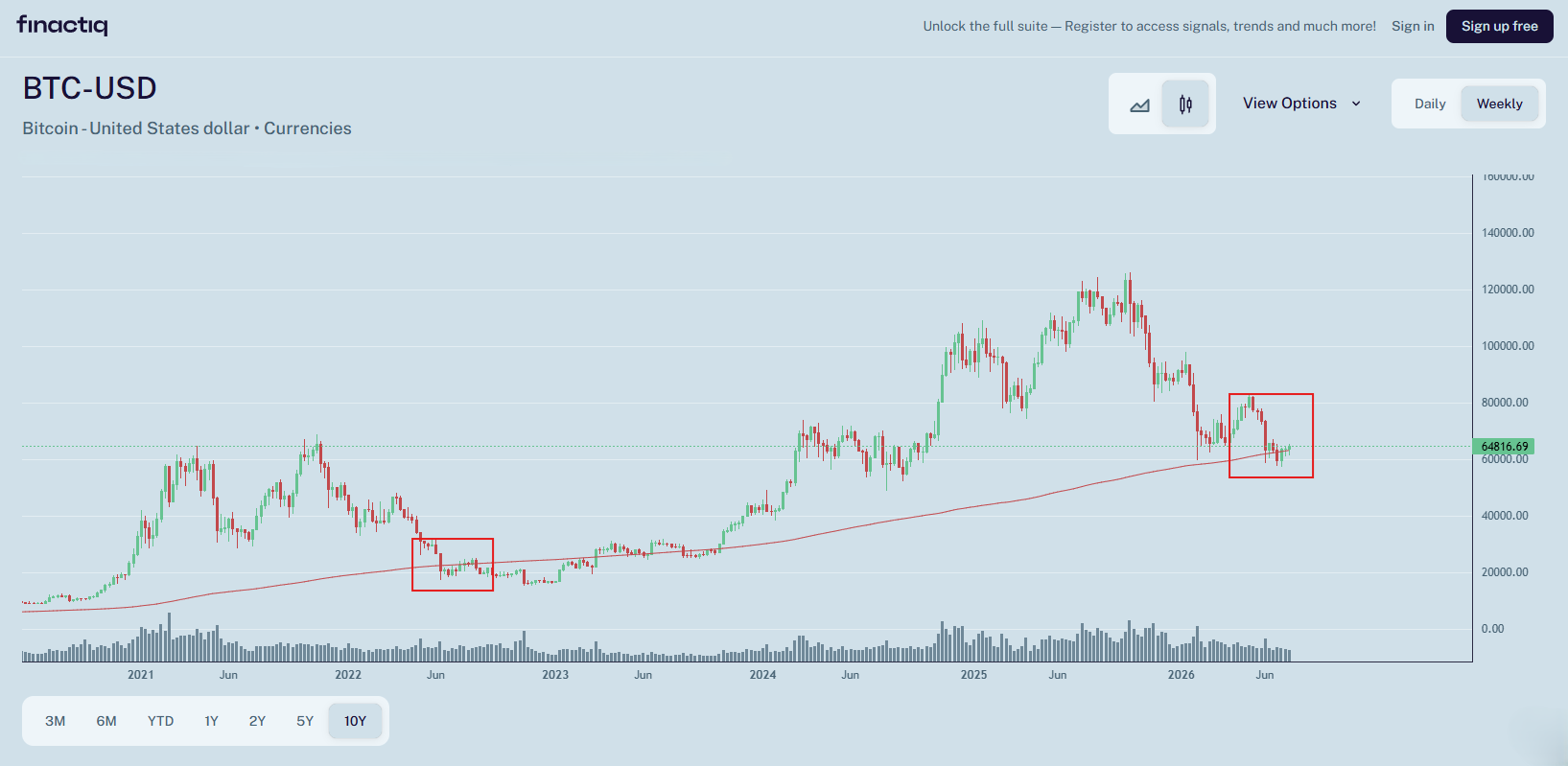
Bitcoin is trading around $60,000–$65,000 as of mid-July 2026 (CryptoTimes), roughly 48–50% below the all-time high of about $126,000 it hit on October 6, 2025 (21Shares). If you've followed Bitcoin through past cycles, that number alone might set off alarm bells. The 2018 crash was an 84% wipeout, from $19,783 down to $3,122. The 2022 crash was 77%, from Bitcoin's then-record $68,789 down to around $15,476 (Yahoo Finance). A 48% drawdown sounds like the early innings of something much worse.
But this cycle isn't behaving like the others, and the reason is regulatory, not mysterious. The U.S. has passed its first-ever federal crypto law, come within a Senate vote of passing a second one, and turned crypto policy into the single largest source of corporate political spending in the country. Miss that story and you'll read this cycle like it's 2018 all over again; it isn't. This is the kind of second-order, policy-driven read Finactiq focuses on: not just where the price is, but the legislative mechanics actually moving it. Here's what's actually going on.
Key Takeaways
- Bitcoin's four-year "halving" cycle just went through its fourth supply cut in April 2024, but the 2024–2028 cycle is unfolding differently than any before it.
- The halving only ever set the stage. Every actual rally (2017, 2021, 2024) was lit by a separate demand shock: a speculative token boom, a stimulus wave, or a new regulated on-ramp.
- The GENIUS Act, signed into law on July 18, 2025, is the first major U.S. federal crypto legislation ever enacted.
- The CLARITY Act, which would define Bitcoin's legal status, has not been signed into law; it still needs a full Senate vote and a presidential signature before the end of 2026.
- The crypto industry has spent $189 million on the 2026 midterms so far, more than any other corporate sector, largely to get CLARITY across the finish line.
- The last two cycles took 12-14 months from peak to bottom, a pattern that, applied here, points to a Q4 2026 low, the same window as CLARITY's deadline.
A 30-Second Refresher: What Is the Bitcoin Halving Cycle?
Bitcoin's monetary policy is written into its code. Roughly every four years (every 210,000 blocks), the reward paid to miners gets cut in half. The most recent halving hit on April 19–20, 2024, dropping the block reward from 6.25 to 3.125 BTC. The next is projected for around April 17, 2028 (block height 1,050,000), cutting it again to 1.5625 BTC (CoinGecko), landing right in the middle of the legislative questions this article digs into.
Fewer new coins against steady demand has historically meant a supply squeeze that pushes prices up, followed by a correction once the rally runs out of buyers, a rhythm that's repeated across every prior cycle, each bust deeper than the last cycle's optimists expected. The 2024–2028 cycle followed that script for a while (new all-time high, media frenzy), then hit a plot twist nobody had priced in: actual federal law.
What Actually Drove Bitcoin's Price Up Each Cycle (It Wasn't Just the Halving)
The halving only tightens the spring. Something else always pulls the trigger. Here's what actually flooded in, cycle by cycle.
2017: The ICO Machine
Ethereum-based Initial Coin Offerings turned Bitcoin and Ether into the mandatory "on-ramp" currency for a token-sale gold rush: you needed BTC or ETH to buy into the next hot project, so demand for both surged as fuel for that trade, independent of any belief in Bitcoin itself (Gemini). When China moved to ban domestic crypto exchanges in September 2017, bitcoin dropped over $1,000 in three days before trading activity shifted elsewhere in Asia (CNBC). Then, right at the top in December 2017, CME and Cboe launched the first regulated Bitcoin futures, a brief institutional legitimacy jolt that arrived just before the crash (CNBC). Again: mostly capital that was already in the system, cycling faster through a speculative token economy.
2020–2021: Stimulus Meets Corporate Adoption
The first cycle where the story genuinely changed. COVID-19 triggered trillions in stimulus and near-zero rates, giving the "debasement hedge" pitch real teeth for the first time (CryptoHopper). MicroStrategy's Michael Saylor put $250 million into Bitcoin in August 2020; Tesla and Square followed (Altrady). PayPal opened crypto buying to roughly 400 million users overnight (CryptoHopper). This is the one cycle where both halves of the money equation moved at once: real expansion, plus new on-ramps moving it faster.
2024–2025: The Regulated On-Ramp
No stimulus this time. The catalyst was infrastructure: the SEC approved spot Bitcoin ETFs in January 2024, and Bitcoin more than doubled that year partly on the approval alone (Reuters, via Yahoo Finance). BlackRock's IBIT became the fastest ETF in history to reach $100 billion, about 435 days, versus 2,011 for the previous record (The Block). Trump's November 2024 election win triggered the largest single-day ETF inflow on record at the time, $1.37 billion (The Block). Through 2025, a new SEC chair, the rescission of the rule that had discouraged banks from offering crypto custody, and finally the GENIUS Act itself all stacked on top of each other (Nasdaq). None of that is money-printing. It's liquidity infrastructure: each policy change made it faster, cheaper, and more legally comfortable for capital that already existed (in 401(k)s, brokerage accounts, bank balance sheets) to reach Bitcoin.
The pattern: the halving narrows supply, but the rally is always lit by something that either pumps new money in (2020) or removes friction so existing money arrives faster (2017's ICO on-ramp, 2024's ETFs). Economists have a shorthand for this: MV = PQ, money supply (M) multiplied by velocity (V, how fast that money changes hands) equals price level (P) multiplied by output (Q). Sometimes M is what moves; there's literally more money in the system, like in 2020. But far more often here, it's V that moves: the same pool of dollars simply reaching Bitcoin faster than before.
The halving narrows the supply. It has never once, by itself, been the thing that actually moved the price.
Why this matters for 2027: GENIUS is a velocity law, full stop. 1:1-backed, 24/7-settling stablecoins are a purpose-built version of the same on-ramp effect that ETFs delivered in 2024, just running continuously instead of during market hours, and open to any compliant institution rather than a handful of ETF issuers. If CLARITY also passes, it would do for direct Bitcoin ownership what the ETF approval did in 2024 and what the custody rule change did in 2025: remove the last major legal-uncertainty friction keeping broker-dealers, banks, and asset managers from touching Bitcoin at real scale. Put in Fisher's terms: GENIUS is already turning up V for dollars reaching crypto markets. CLARITY, if it passes, would be the moment the pool of eligible capital (M, in effect) meaningfully widens too. That combination may matter more for 2027+ than the 2028 halving itself.
The Law That's Already Real: The GENIUS Act
On July 18, 2025, President Trump signed the Guiding and Establishing National Innovation for U.S. Stablecoins Act into law, the first significant federal crypto legislation the U.S. has ever enacted (Sidley Austin).
- Forces 1:1 backing. Stablecoin issuers must hold liquid reserves, cash or short-term Treasuries, equal to every token in circulation.
- Bans issuer interest. Issuers can't pay you interest for holding, keeping them from functioning like unregulated banks.
- Opens the door for Wall Street. Legalizing the plumbing lets banks and payment networks use blockchain settlement with legal confidence.
- Phases in through January 2027. Core restrictions take effect the earlier of January 18, 2027, or 120 days after final rules (Sidley Austin); its biggest effects are still arriving.
GENIUS doesn't regulate Bitcoin directly, but it legitimizes the rails institutional money uses to get into crypto, with Bitcoin the obvious destination. That's already happened.
The Law That Isn't Real Yet: The CLARITY Act
A lot of crypto commentary treats the Digital Asset Market Clarity Act (H.R. 3633) like settled policy. It is not law: it's passed one chamber and one committee, nothing more.
What it would do, if passed:
- Create three legal categories (digital commodities, investment contract assets, payment stablecoins), replacing rules inferred from SEC enforcement (Blockchain Council).
- Split SEC/CFTC jurisdiction. CFTC gets exclusive authority over "digital commodities"; SEC keeps investment-contract assets (SEC filing, Valkyrie ETF Trust II).
- Add a "decentralization test" letting a token graduate from security to commodity once certified sufficiently decentralized (McGraw Hill Education), formalizing Bitcoin's commodity status rather than assuming it.
- Impose registration rules on exchanges, brokers, and dealers, plus tighter issuer disclosure (SEC filing).
- Restrict a U.S. central bank digital currency: a rider barring the Fed from using a CBDC for monetary policy (Congress.gov).
- Settle the fight over exchange "rewards," capping passive APY-style rewards in favor of activity-based perks (Latham & Watkins Policy Tracker).
| Date | Milestone |
|---|---|
| May 29, 2025 | Introduced in the House |
| July 17, 2025 | Passed the House, 294–134 |
| September 18, 2025 | Received by the Senate |
| January 12, 2026 | Senate Banking releases draft text |
| May 14, 2026 | Senate Banking Committee approves it, 15–9 |
| June 1, 2026 | Placed on the Senate calendar |
Sources: Latham & Watkins Policy Tracker, CryptoSlate, Skadden
It still needs a full Senate floor vote, reconciliation with the House version, and a signature, all before December 31, 2026. Prediction markets put the odds around one-in-three to even-money (CryptoSlate), a coin flip on major financial legislation, not a foregone conclusion.
The Money Story: Why Stablecoins Matter Even Without a Bitcoin Law
If the history above proves anything, it's that velocity, not printed money, has been the recurring engine behind Bitcoin's rallies. Stablecoins don't expand the money supply: GENIUS requires full 1:1 backing, so issuance doesn't create dollars the way fractional-reserve lending does.
What it does is increase velocity, the V in the MV = PQ shorthand from earlier, and the same force behind 2017's ICO rush and 2024's ETF flows. Programmable, 24/7 stablecoin settlement lets capital circulate far faster than ACH or FedWire, more economic throughput from the same dollars, without the Fed printing a cent. That tailwind is already locked in, regardless of CLARITY.
Comparing the Cycles: 2018 vs. 2022 vs. 2026
| Cycle Peak | Catalyst for the Crash | Max Drawdown | Legal Backdrop |
|---|---|---|---|
| Dec 2017 | ICO bust, Asian regulatory bans | ~84% | "Regulation by enforcement" |
| Nov 2021 | Fed rate hikes, FTX/Luna collapse | ~77% | Legal ambiguity |
| Oct 2025 | ETF outflows, macro/tariff tension | ~48–50% (ongoing) | GENIUS enacted; CLARITY pending |
Sources: Yahoo Finance, 21Shares
The 2026 correction is real and not over, but it's shallower than every prior crash by a wide margin (21Shares). Realized price (the average cost basis of current holders) sits much closer to the top than in past cycles, with institutions, not retail FOMO, increasingly setting the marginal price (21Shares).
Why Crypto Companies Just Became America's Biggest Political Spenders
If you want proof that the industry believes regulatory clarity is worth fighting for, follow the money. Crypto firms have poured $189 million into the 2026 midterms so far, about 37% of all corporate political spending tracked this cycle, more than any other industry (Public Citizen). Most of it runs through Fairshake, the industry's bipartisan super PAC, backed heavily by Coinbase, Ripple, and Andreessen Horowitz. This isn't abstract lobbying; it's a direct bet that getting CLARITY passed (or protecting GENIUS from rollback) is worth more than nine figures to the companies writing the checks.
What About Interest Rates and the National Debt?
This is the part of the story that rarely makes crypto headlines, but probably should. As of December 2025, foreign investors held about 31% of U.S. publicly held federal debt, down from a much larger share historically, with China's slice of foreign-held Treasuries now at its lowest level since 2001 (Congressional Research Service).
Every stablecoin backed 1:1 by Treasuries under GENIUS is, in effect, new structural demand for U.S. government debt, demand that doesn't care about yield the way a hedge fund does, because it's mandated by law. As the stablecoin market keeps growing, this becomes a small but real offset to fading foreign appetite for Treasuries, with knock-on effects for borrowing costs across the economy. This dynamic doesn't depend on CLARITY passing; it's already running.
Four Scenarios for 2027 and Beyond
Bitcoin's next chapter forks depending on Washington, and forks well before the next halving. GENIUS has already turned up V; whether CLARITY expands M is the whole ballgame.
| Scenario | If CLARITY... | Likely Outcome |
|---|---|---|
| The Supercycle | Passes in 2026, timed like prior cycles' bottoms | If passage lands in the same Q4-2026 window history's timing points to, it could end the drawdown rather than just add a headline, a shallower low than 2018/2022's 77-86%. |
| Steady Institutionalization | Stalls but survives into 2027 | GENIUS-driven stablecoin growth keeps institutionalizing, just more slowly. |
| Macro Headwind Dominance | Passes or stalls | High rates or a liquidity crunch overwhelm regulatory tailwinds regardless of timing. |
| Legislative Collapse | Dies entirely in 2026 | Institutionalization plateaus at GENIUS's ceiling; SEC/CFTC ambiguity and a legal-risk discount persist. |
No one has a crystal ball on which path we're on, but knowing the fork exists separates a useful read from a superficial one. Finactiq will keep tracking the Senate calendar alongside the price chart, since the two are more connected this cycle than the headlines suggest.
GENIUS already turned up how fast money moves into crypto. Whether CLARITY passes decides how much money is even allowed to make that trip.
Same Shape, Different Trigger: Is the Timing a Coincidence?
Here's a pattern worth sitting with. The 2017 cycle peaked in December 2017 and didn't bottom until roughly 12-14 months later, in December 2018. The 2021 cycle peaked in November 2021 and bottomed about 12 months later. Apply that math to this cycle's October 2025 peak, and it points to a bottom around Q4 2026 (Yahoo Finance), the same window as CLARITY's December 31 deadline, sitting right after the midterms the industry has poured $189 million into influencing.
So: coincidence, or something else? There's a real case for both. The case that it's not entirely coincidence: the industry didn't stumble into this timing. Fairshake and its allied super PACs built a $193 million war chest specifically to influence the November 2026 midterms and push CLARITY across the finish line before the year-end deadline. If that campaign works and the bill clears in Q4 2026, it would be landing, by design and not luck, in the same few months that an entirely separate, mechanical process (the halving cycle's historical bottom-timing) already pointed to independently. The case that it's just a coincidence: the halving cycle's rhythm is driven by mining economics, leverage unwinds, and long-term holder psychology, a process with zero awareness of the congressional calendar. Congress's own clock (committee schedules, a 60-vote threshold, a self-imposed year-end deadline) is a completely independent system. Two unrelated processes landing in the same few months out of a 12-14 month window isn't actually that improbable.
The chart could end up rhyming with 2018 and 2022. The reason wouldn't rhyme at all.
That may be the more interesting version of "this cycle is different": the fundamentals have genuinely changed, but if CLARITY news lands in that same Q4-2026 window, the price chart could still trace a familiar shape (a defined low, then a new leg up), just with a regulatory vote sitting where a halving-driven supply squeeze used to sit. This isn't a prediction: Scenario C above doesn't care what month a bill passes, and a recession or high-rate environment could push Bitcoin lower regardless. The overlap is a pattern worth watching, not a signal to trade on.
Frequently Asked Questions
Is the CLARITY Act law yet?
No. It has passed the House and a Senate committee but still needs a full Senate vote, reconciliation with the House version, and a presidential signature (Latham & Watkins Policy Tracker).
What's the difference between the GENIUS Act and the CLARITY Act?
GENIUS regulates stablecoins and is already law (July 18, 2025). CLARITY would define Bitcoin's legal status more broadly and is still a bill in Congress.
Why has Bitcoin's crash been smaller this cycle?
A combination of institutional-heavy ownership, GENIUS Act-driven legitimacy, and reduced (though not eliminated) regulatory panic appears to be cushioning the drawdown compared to 2018 and 2022, though analysts disagree on how much credit belongs to regulation versus simple market maturation.
Will Bitcoin get back to $126,000?
Analysts are split: some models point to recovery by late 2027–2029, others to a lower bottom first (StealthEX). No one can say this with certainty.
Is the four-year halving cycle dead?
Not conclusively, but it's weakening. If institutional and regulatory forces continue to dominate price action the way they have this cycle, the halving's influence on timing is likely to fade further, though it hasn't disappeared yet.
When is the next Bitcoin halving?
Around April 17, 2028, at block height 1,050,000, cutting the reward from 3.125 to 1.5625 BTC (CoinGecko), after both GENIUS's full effective date and CLARITY's current deadline.
What actually causes Bitcoin's price to go up?
The halving's supply cut only sets the stage. Rallies were each lit by a separate demand shock: ICOs in 2017, stimulus and corporate adoption in 2020, ETF approval in 2024, with velocity, not new money supply, as the common thread.
Could this cycle's bottom line up with the CLARITY Act by coincidence?
Possibly. The last two cycles' 12-14 month peak-to-bottom pattern, applied here, points to a Q4 2026 low, the same window as CLARITY's deadline. That could reflect deliberate industry timing around the midterms, or two unrelated processes simply overlapping. Neither explanation can be confirmed in advance.
Disclaimer
Finactiq Limited (NZBN: 9429052500688) is a technology company, not a registered investment advisor, broker-dealer, or licensed financial advisor. This article is provided for informational and educational purposes only and does not constitute personalized investment, financial, legal, or tax advice. Past performance, backtested results, and any figures cited are not indicative of future results. All trading and investing involve risk, including the possible loss of principal. Figures on legislative status, prices, and political spending are current as of publication and may change quickly; verify against primary sources (Congress.gov, sec.gov, treasury.gov) before relying on them.
© 2026 Finactiq